STUDIOS Architecture Paris and Selldorf Architects Wins “Louvre Nouvelle Renaissance” Competition
The below press release has been translated to English. The original can be found here.
Catherine Pégard, France’s Minister of Culture, has announced the winning team of the international architectural competition for the Louvre Nouvelle Renaissance: STUDIOS Architecture Paris and Selldorf Architects. The two main objectives of this grand undertaking are to repair and transform the building.
Announced by the President of the Republic in the presence of the Minister of Culture and the Mayor of Paris, nearly 40 years after the Grand Louvre project and its iconic Pyramid imagined by architect I.M. Pei, this plan responds to a significant need for renovation and transformation of the museum in order to sustainably preserve the Louvre’s architectural heritage, better protect and share its collections, and adapt the institution to the expectations of its audiences. The program also addresses sustainability imperatives, which will be among the museum’s central challenges in the coming decades.
Within this broader framework of technical upgrades and modernization to meet contemporary challenges, the “Grande Colonnade” competition marks a major milestone. It prepares the museum for a new chapter in its history: highlighting the Louvre Colonnade, a masterpiece of classical architecture; reconnecting this unique heritage site with the city; and making it more accessible to all audiences. Through new entrances and circulation routes organized from the eastern side of the estate, along with a redesign of the surrounding public spaces, the project aims to sustainably improve visitor reception and staff working conditions within the world’s most visited museum.
The highly qualified jury, chaired by Marc Guillaume, Prefect of the Île-de-France Region and Prefect of Paris, with Christophe Leribault, President-Director of the Louvre Museum, serving as vice-chair, convened on May 13 in the presence of Emmanuel Grégoire, Mayor of Paris, to review the proposals submitted by the five shortlisted teams. Following deliberations, during which the jury praised the high quality of the submissions, the project proposed by STUDIOS Architecture Paris and Selldorf Architects was selected for the excellence of its architectural vision and its integration into the site’s heritage, urban, and landscape context. The proposal fully incorporates key concerns related to visitor reception, clarity of circulation, restraint and greening, while also thoughtfully addressing security considerations.
The Winning Team
STUDIOS Architecture Paris, lead firm of the winning team and headed by James Cowey, is the French office of an international collective founded in 1985 with offices in New York City, Washington, San Francisco, Los Angeles, and Toronto. Among its major cultural projects are the Fondation Louis Vuitton and the Fondation LUMA, both realized alongside Gehry Partners.
Selldorf Architects, the associated design firm, was founded in New York in 1988 by Annabelle Selldorf. The firm designs public and private spaces that combine contemporary sensitivity, restraint, and sustainability. It is especially recognized for its expertise in complex cultural projects, including major renovations such as The Frick Collection in New York and the Sainsbury Wing of the National Gallery in London, both widely praised for their architectural quality and seamless integration into existing structures.
Selldorf Architects will also oversee exhibition and museum design. BASE Landscape Architecture is responsible for landscape and urban planning.
The Project by STUDIOS Architecture Paris and Selldorf Architects
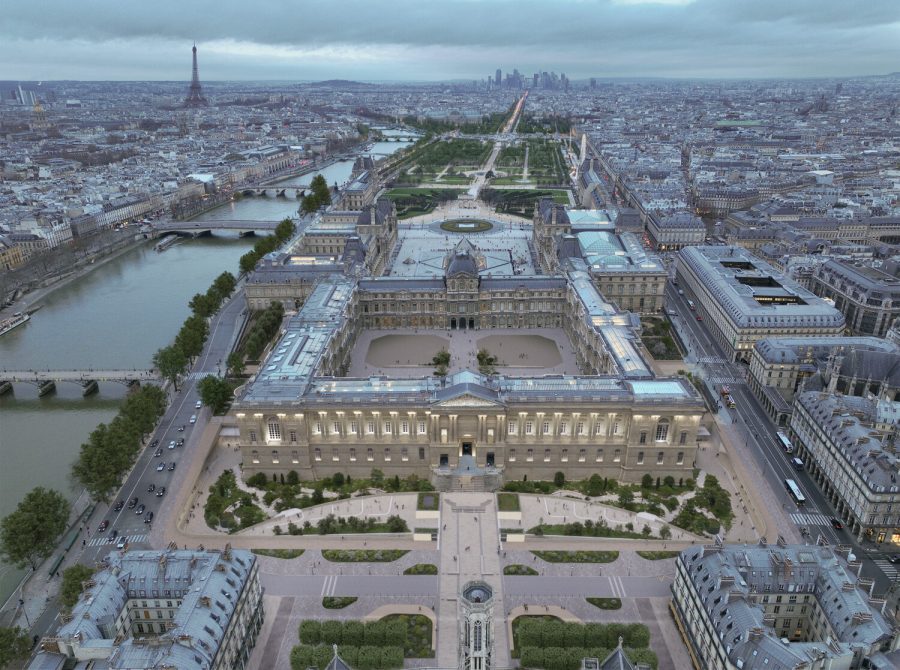
The winning team brings a respectful yet contemporary momentum to the Colonnade entrance project. Combining urban, architectural, and landscape vision, the proposal creates an elegant connection between the city, the palace, and the museum, while developing a sensitive geography of movement attentive to the visitor experience from the surrounding public spaces through the interior of the museum.
A strong symmetry centered on the East-West axis and the clarity of circulation routes structure the overall composition.
From the belfry facing the Louvre, the historic East-West axis is reactivated, organizing visitor arrival through a calm and harmonious public space stretching from Saint-Germain-l’Auxerrois to the Louvre esplanade, culminating in a clear entry point facing the Colonnade.
The original perspective—extending from the Cour Carrée and the Pyramid through the Carrousel and Étoile triumphal arches to the Grande Arche de la Défense—regains full continuity here through a belvedere designed for contemplation of the Louvre façade. It also offers views over the transformed and landscaped moats, which will provide a cooling green refuge.
The descent into the moats will occur primarily through two symmetrical gently sloping ramps, creating a clear and partially sheltered pathway carved into the thickness of the stone retaining wall.
The overall balance between mineral and vegetal elements contributes to visitor comfort and climate resilience. New restaurant and bookstore-boutique spaces, installed beneath the ramps and within the recessed wall structure, will be accessible to all from the moat level.
Two new underground museum entrances located on either side of the moats—toward the Seine and Rue de Rivoli—will lead to clear and functional reception areas opening onto new exhibition spaces and the dedicated Mona Lisa space, all connected to the museum’s other galleries.
A Beginning: A Collective Story in the Making
Catherine Pégard welcomed the designation of the winning team as a foundational step in launching the Louvre’s transformation. In the coming months, through close dialogue between the Louvre and the selected team, a consultation period will begin to further refine the project with all stakeholders involved.
This consultation process will first involve those who bring the Louvre to life every day—its staff—in coordination with all parties contributing to this collective endeavor (the City of Paris, state services responsible for heritage and security, etc.), before expanding to the public.
Key Elements of the “Grande Colonnade” Competition Program
- Better welcome visitors and improve circulation through the creation of a new entrance on the building’s eastern façade and new circulation routes designed to “open up” the Louvre and distribute visitors more evenly throughout its galleries;
- Highlight the Louvre’s historic entrance—the Colonnade, one of the masterpieces of French classical architecture—and its esplanade through a newly landscaped composition;
- Reconnect the Louvre with the city through the redesign of the urban space in front of the Colonnade;
- Create a dedicated space for the Mona Lisa, allowing visitors to discover and contemplate the work under satisfactory conditions;
- Provide the Louvre Museum with a high-level modular temporary exhibition space;
- Renew the visitor experience and comfort through new relaxation and service areas (restaurants and bookstores/boutiques), making the Louvre more welcoming both inside and outside the museum.