Renovated Spanish and Italian Galleries Reopen
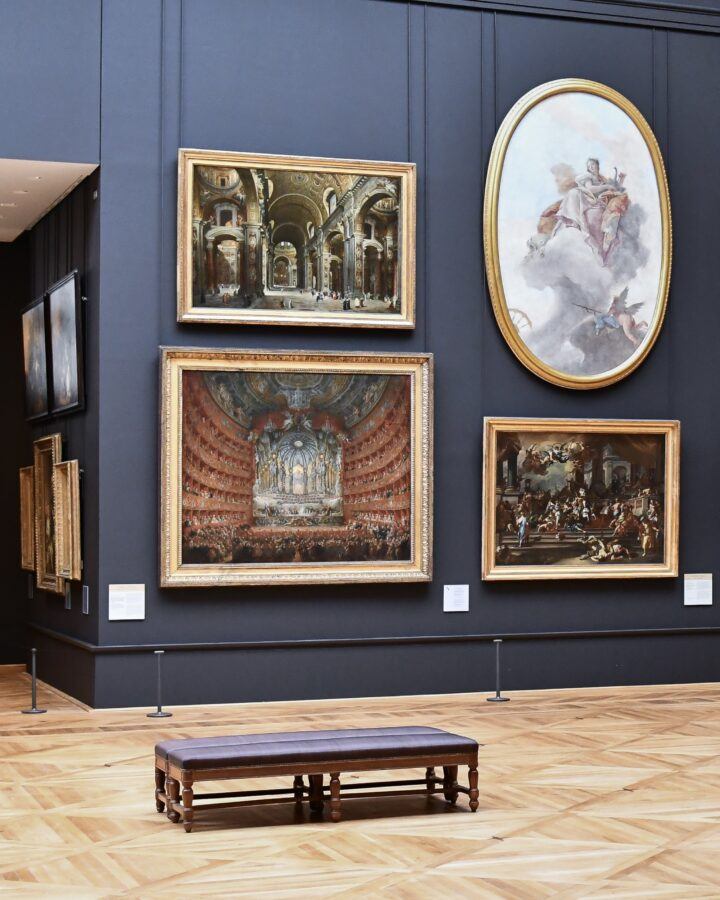
The Louvre Museum and American Friends of the Louvre announces the reopening of the renovated rooms of Italian and Spanish paintings from the 17th and 18th centuries, where the artworks are presented in a redesigned museography. The arrangement has been modified based on acquisitions and loans made externally, but it has also allowed for a closer examination and care of the artworks.
Near the Grande Galerie, where around a hundred paintings created in Bologna and Rome during the first half of the 17th century are displayed, visitors can discover works in the Salvator Rosa room. The works created in Rome from the second half of the 17th century are now visible again. Notably, three paintings by Salvator Rosa, the great Neapolitan painter active in Rome, introduce the Neapolitan school represented by Luca Giordano. Additionally, works from Genoa, Florence, Milan, and Venice offer another perspective on painting from this period.
The first phase of the renovation of the Spanish painting rooms at the Louvre, planned for 2025-2026, has been completed. The Murillo Room (718) once again hosts large-scale works from the 17th century, which benefit from new mediation devices. Recently restored large-scale works, particularly the four episodes of the life of Saint Bonaventure painted by Francisco de Herrera el Viejo and Francisco de Zurbarán for the San Buenaventura College in Seville in 1628-1629, have regained their monumental power and vibrant color palette and are now presented to the public again.
From the Murillo Room, the eye is drawn to Room 719, dedicated to Spanish paintings from 1750 to 1850, where the exceptional collection of Francisco de Goya’s paintings is highlighted. This includes full-length portraits of Spanish nobility, such as the Marquise of Santa Cruz and the Marquis of Cistué (currently displayed at the Louvre-Lens), as well as portraits of the artist’s close acquaintances, such as Don Evaristo Pérez de Castro. The highlight of this room is the portrait of Ferdinand Guillemardet, ambassador of the French Republic to Madrid, painted by Goya in 1798.
The redesigned museography of the room has also introduced a novelty to offer a more comprehensive view of the artist: four copper plates engraved by Goya for his “Disparates” series, acquired in 2011. These strange scenes (a “rain of bulls” or a “beastly absurdity”) invite visitors to discover another technique explored by the artist with boldness and freedom, revealing a dark and grotesque aspect of his work, contrasting with his luminous portraits.
Among the works temporarily sent to storage for examination, cleaning, and restoration is A Miracle of Brother Francisco by Bartolomé Esteban Murillo, also known as The Angels’ Kitchen, an oil on canvas measuring 4.50 meters. This painting, which presented conservation issues, is currently undergoing fundamental restoration. It is the only signed canvas from the first major commission received by the young Murillo in 1646, a series now dispersed, painted for the small Franciscan cloister in Seville. Its very original iconography—depicting a Franciscan brother discovering that angels have miraculously prepared the meal he was responsible for—has always been a great success with visitors since its entry into the museum in 1858. After being studied at the Center for Research and Restoration of Museums of France (C2RMF), the painting was entrusted to restorers Alix Laveau and Giusy Dinardo for the pictorial layer, and Jean-Pascal Viala and Luc Hurter for the support. It will return to the rooms in autumn 2026.
In 2026, the adjacent rooms, the “Small Southern Cabinets” (Rooms 730 to 734), will be renovated to exhibit Spanish and Portuguese paintings of small and medium formats from the 14th to the 19th century.
The renovation of the Spanish galleries has benefited from the generous support of the American Friends of the Louvre, the Sada Melo Family in memory of Federico Sada González, Naoma Tate, and Lionel and Ariane Sauvage.
To learn more about this project, please contact us at info@aflouvre.org.
#####